
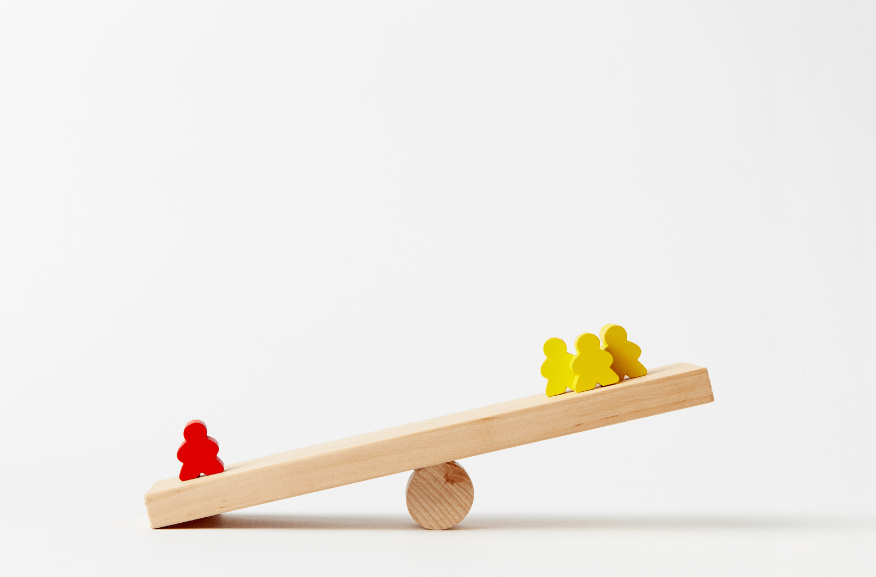
What is your relationship dance? (Part 3: The Seesaw)
The Seesaw is a common relationship dance found not only in couples but also in our daily interactions with the people around us. In this dynamic, one person starts to take on more responsibilities (“overfunctioning”) while the other becomes increasingly dependent (“underfunctioning”).
The more one partner “overfunctions,” the more the other “underfunctions,” and vice versa. Here are some examples of overfunctioning and underfunctioning behaviors:
- Overfunctioning: Making sure your partner wakes up on time, telling them how to answer an email, helping them write holiday cards to their family members
- Underfunctioning: Always asking your partner where your clothes are, letting them decide what to order at a restaurant, relying on them to remind you when your next dentist appointment is
Over time, this pattern can gradually become ingrained in the relationship, where each partner is fixed in the role of either being an overfunctioner or an underfunctioner.
I find this dynamic to be quite intriguing because it’s easy to understand the behaviors but tricky to change. Although the “overfunctioner” may complain about feeling overwhelmed with all the responsibilities, they also find it easier to overfunction than to wait for their partner to step up, possibly making mistakes in the process. On the other hand, the “underfunctioner” may complain about constantly being nagged and not being trusted with important tasks, but they also find it easier to let the other take control to keep their partner calm.

It is important to remember that “overfunctioning” and “underfunctioning” are not personality traits, meaning we are not fixed in either way. Rather, they are behaviors that indicate how we function in relation to the person we are in a relationship with. Just think about how someone in an executive position can overfunction at work but begin to underfunction once they are at home.
The seesaw dynamic is a reciprocal process – one can only overfunction as much as the other allows them to function for them. In fact, if this is a true seesaw, meaning it goes up and down on a regular basis where roles shift back and forth, this makes a healthy relationship because we can complement each other’s strengths and weaknesses. However, what we often see in the seesaw dynamic is that the seesaw is stuck in one direction, and that there isn’t any flexibility in the relationship. This is when issues can accumulate in the long-run.
To gain insight into your own relationship dynamic, ask yourself the following questions:
- Is there anything I always let my partner do for me, even though I am perfectly capable of doing it myself (even if I might not do it as well)?
- How often do I want to take over because waiting for my partner to act or seeing them do things differently makes me uncomfortable?
By reflecting on these questions, you can better understand your role in the seesaw dynamic and potentially work towards creating a more balanced and flexible relationship.
Thanks for reading!
Maybo


 Couples on the Road Counselling